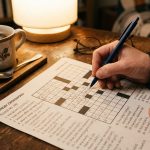
Staring at an empty black-and-white grid can feel intimidating for newcomers. But solving easy crossword puzzles is not a test of raw IQ or encyclopedic memorization; it is simply a language with its own established rules, signals, and grammar. Once you understand the secret agreements between constructors and solvers, the grid unlocks with effortless satisfaction. This guide breaks down the essential mechanics, clue types, and tactical habits that will turn you into a confident solver.
The Golden Architectural Rules of Crosswords
Professional crosswords in major publications follow strict, traditional construction standards:
- 180-Degree Rotational Symmetry: If you rotate a standard American crossword grid upside down, the pattern of black squares remains completely identical.
- Full Interlocking: Every letter in an Across answer must also form part of a valid Down answer. There are no “unchecked” or isolated letters.
- No Repeat Words: A constructor may never use the exact same answer word twice in the same puzzle.
- Grammatical Matching: The clue and answer must always share the same part of speech, tense, and number. If a clue is plural, the answer is plural; if a clue is past-tense, the answer is past-tense.
Decoding the 5 Major Clue Types
Constructors communicate in code. Here is how to translate the five most common clue styles you will encounter in easy crossword puzzles:
1. Direct Synonyms: The simplest clue style. For example, “Swift” leads directly to FAST or RAPID.
2. Fill-in-the-Blank (FITB): Often denoted with underlines, such as “___ of Arc” (JOAN) or “Ready, ___, go!” (SET). These are golden entry points because they have very few alternatives.
3. Abbreviation Flags: If the clue contains an abbreviation or hints at short speech (like “Govt. tax agency” or “Briefly”), the answer will also be an abbreviation (IRS).
4. Question Mark Wordplay: A question mark at the end of a clue warns you of a pun or double meaning. For example, “Bark provider?” does not refer to a veterinarian, but to a TREE or a DOG.
5. Cross-Referenced Clues: Clues that point to other grid answers, such as “Partner of 14-Across”. Solve the anchor clue first to unlock the pair.
5 Winning Habits for Beginner Solvers
To breeze through daily grids with confidence, apply these proven solver habits:
- Hunt for the Fill-in-the-Blanks First: Scan the entire clue list for blanks and direct pop-culture trivia you know instantly. These give you guaranteed letter hooks.
- Work in Clusters: Rather than solving purely from 1-Across down to the bottom, work in tightly connected quadrants. Use the letters you just placed to trigger intersecting answers.
- Leverage Common Crosswordese: Crosswords frequently rely on short words rich in vowels. Familiarize yourself with ubiquitous entries like ERIE, ALOE, ARIA, AREA, and OREO.
- Check Word Endings: If you see a plural clue, pencil in the ending letter S immediately. If you see past tense, pencil in ED.
- Trust Your Subconscious: When stuck on a clue, step away for five minutes. Your brain continues to process phonetic and semantic associations in the background.
Frequently Asked Questions
What day of the week has the easiest crossword puzzles?
In most syndicated newspapers (including The New York Times and USA Today), Monday puzzles are the easiest, with difficulty gradually increasing toward Saturday.
Are easy crosswords good for beginners?
Yes. Easy puzzles focus on direct definitions and familiar idioms, allowing new players to learn the rhythm of intersecting letters without frustrating trivia traps.
What should I do when I get completely stuck?
Look for short 3- and 4-letter words with common vowels, check the grammar of clues, or reveal a single intersecting letter to get your momentum rolling again.
Crossword solving is a skill that compounds with every single puzzle you complete. Sharpen your pencil or tap into a relaxing game of easy crossword puzzles on easy-crossword-puzzles.com today!