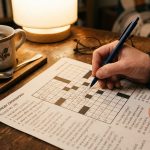
Easy Crossword Puzzles rewards a small change in attention. An easy grid should feel welcoming without feeling empty, which is why clue grammar matters even at the beginner level. Players often lose time not because the puzzle is impossible, but because they keep looking at it in the same order. A better routine creates a short pause, identifies the strongest evidence, and then makes a move that leaves the next choice easier. That is a practical skill, not a performance trick.
Easy Crossword Puzzles in practice
Start with the clues that give something back
An easy crossword is not solved by moving from the top left to the bottom right. It is solved by collecting reliable letters. Begin with direct definitions, familiar short answers, and clues whose grammar is obvious. Each answer should make the next clue easier. If a clue gives you nothing after a fair look, skip it and protect your attention.
That approach keeps the grid moving without making the session feel like a test. The goal is not to prove that every answer was known in advance. It is to let the crossings create knowledge as you go.
Treat almost-right answers as temporary
The most common beginner trap is the attractive answer that fits the clue but not the crossings. Leave uncertain entries light. When one crossing disagrees, test the answer before defending it. A wrong letter is useful if it tells you where the earlier assumption failed; it becomes expensive only when you build more guesses on top of it.
Short grids make this lesson visible because there is nowhere for a weak answer to hide. If the board feels stuck, look for the entry with the most uncertain letters and remove the part that is least supported. Often the puzzle opens again immediately.
Build a repeatable first pass
Use one pass for direct clues, one for crossings, and one for entries with special punctuation or wordplay. Play a daily crossword on Easy Daily Puzzle and browse more crossword tips on this site. The Britannica crossword overview is a useful external refresher when you want the broader context.
A practical habit to try today
Use the first pass to collect answers with strong clue grammar, not to prove how much trivia you remember. Note whether the clue is singular or plural, past or present tense, shortened, quoted, or marked as playful. Those signals often narrow the answer before the crossings do. They also help you notice when a clue is asking for a phrase rather than a dictionary definition.
When a clue stalls, leave it visible and move to a crossing-rich entry. A new letter can change the reading of the surface, and that change is often more valuable than another minute of staring. Hints work best in the same way: take only enough help to create a new decision, then return to the grid and test the answer yourself.
At the end of a solve, review the answers you changed. Do not only count mistakes. Ask what kind of signal you missed. Was the tense wrong? Did you ignore an abbreviation? Did one crossing expose that the clue was a pun? Naming the pattern makes the next puzzle feel easier without requiring memorization of a long answer list.
For the next session, play a fresh crossword on Easy Daily Puzzle and browse more crossword guides on this site. The aim is not to finish every grid without help. It is to make each hint, crossing, and correction teach you something you can use on the next page.
The small detail worth remembering
The best clue habit is flexible rather than rigid. Sometimes the answer arrives from definition, sometimes from a crossing, and sometimes from noticing that the clue is asking for a different part of speech. Good solving means changing the route without losing the standard of proof.
When the grid finally closes, keep one lesson from the puzzle. A new abbreviation, a punctuation signal, or a useful crossing pattern is more valuable than memorizing the entire answer list. That is how a daily crossword quietly builds skill.
A short pause before entering an uncertain answer is often enough to preserve the rest of the grid. The clue will still be there, and the next crossing may give it a better shape.
For a little more context, read Britannica’s crossword history and American Crossword Puzzle Tournament. These references are useful for checking the basic history or rules without turning a daily game post into a long reference list.